Friday, June 8, 2012

Mike Wiley, Rob Underhill, and the film "Dar He: the Lynching of Emmett Till"

There were two films that I saw in the Black International Cinema festival that really stood out.  I do want to point out that I did not see EVERY film in the festival, so I may have missed some really great things, but I did see an awful lot.

One of these two very special films was and is:  Dar He:  the Lynching of Emmett Till.  It is directed by Rob Underhill and stars Mike Wiley.
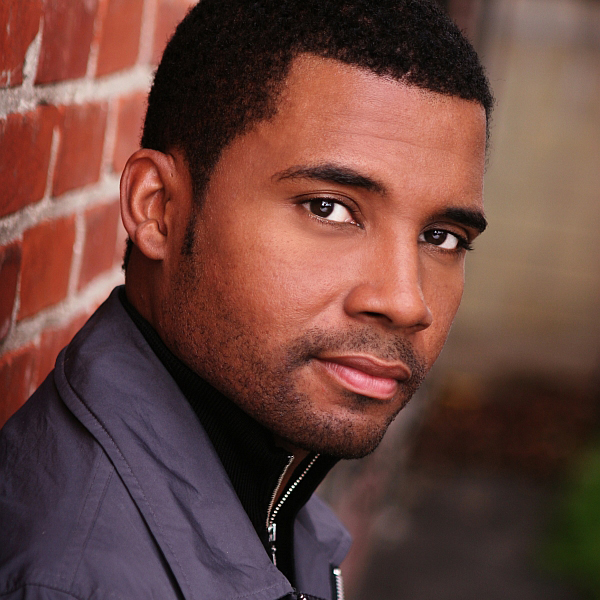
Mike Wiley, the masterful and versitile actor and writer.

I should say that it stars, and stars, and stars...Mike Wiley, who wrote the stage play from which the film was made, plays ALL 36 ROLES in the movie.  And he does it so well that you leave not thinking about his incredible acting skills, but about...the lynching of Emmett Till.

Hooray for him.

And hooray for Rob Underhill, who did some pretty fancy stuff in directing the film but again, the fancy stuff doesn´t stand out.  What stands out is the story, and that´s what a good director wants.

Dar He is about a real incident.  Many of you will have heard of it.  A teenager, 14-year old Emmett Till of Chicago, went to a small town in Mississippi to visit his relatives.  Emmett was black, and this was in 1955, in the days of segregation in the south.


Rob Underhill,  the director and co-script writer.

Acting on a dare that his cousins and friends made, Emmett said something like "you´re cute" or "hey sweetie" or something of that sort to the white woman worker in a dry goods store where he went to buy some candy.  When he left the store, the woman came out and he whistled at her.  Emmett had a speech impediment, and the whistle may have been due to that, or it may have been intentional, and due to the dare.

In any event, for this, he was first tortured and then murdered by the woman´s husband and a friend of that husband.  They dumped his body in the river.

The two men were tried, found innocent, and freely admitted they had done the deed.  And in the days immediately after the trial, they were congratulated by many of their white friends and neighbors for upholding "southern values."  Again, this was the segregated south.

A legal note:  once found innocent of a crime, you cannot be retried for that same crime.  It was therefore not possible to retry them after the trail ended, even with their admission of guilt.

The murder of Emmett Till and the outrage it caused is a major element in the growth of the Civil Rights movement.


Again, Mike Wiley as actor, Rob Underhill as director, the two of them as co-authors of the movie script, and the technicians (Aravind Ragupathi and Larry Gardner) who filmed and then composited all those shots so that you saw Mike Wiley playing several different roles on screen together, did an excellent
job.  I highly recommend this movie

OUR NEXT POST will be about Africa:  the Beat, by director Samaki Wanne.

Friday, May 25, 2012

The multi-talented Dr. Donald Griffith, organizer of Black International Cinema*

There is an article (in German and English) in the 2011 program book for the Black International Cinema festival of Berlin entitled ¨Great accomplishments by a multi-talented artist regarding international exchange:  Dr. Donald Muldrow Griffith."

The term "multi-talented" is completely appropriate.

I know Dr. Griffith as the organizer and presenter of the Black International Cinema festival, and as the host and director of the television program "the Collegium."  I also know through conversations that he started his professional life as a psychological therapist.

Those, however, do not fully describe him and his work.  He is also a dancer, and co-founder plus director/producer of the Fountainhead Tanz Theatre of Berlin.

Born and raised in Chicago, his father was a psychologist and his mother, a concert pianist.  Dr. Griffith trained as a therapist, and practiced that profession but at the same time, partly due to native ability and inclination and partly due to the pressures of his work, he began studying acting and dance.  At a certain point, he decided to leave the psychological profession and devote himself more fully to the arts.

He performed in several musicals including "Stop the World, I Want to Get Off," and won several awards including "Best New Off-Broadway Actor."  As a dancer, he performed in several companies in New York and Chicago, acting at times as solo dancer.

He also acted as manager for Oscar Brown, Jr., for a period.

As if this were not enough, he began acting and found roles in both television and regular cinema.

In the late 1970s, The Belin Theater des Westerns invited him to come to that city to act as performer and choreographer.  As time passed and he realized he enjoyed cultural exchange and the Berlin life, in 1980 he and several collegues founded the Fountainhead Tanz Theatre.

And in 1986, he founded the festival that is now called the Black International Cinema festival.  A truly international festival, this year (2012), it screened films from several African countries, from the United States, from severl middle-eastern countries and from Europe.  The festival does not normally give prizes, but instead seeks to promote intercultural exchange and serve the black community of Berlin.

In 2009, he founded the television program, The Collegium.  An interview show, its most famous guest is Pres. Barack Obama.  It airs regularly in Berlin and throughout Europe.  Dr. Griffith is producer, director and host.

So you can see, the term "multi-talented" is indeed best to use when describing the life and activities of Dr. Donald Muldrow Griffith.

*Material for the article came from personal conversations with Dr. Griffith, on-line research, and from an article by Shiu-Chin Yu in the 2011 program of the Black International Cinema.

OUR NEXT POST will be about Mike Wiley, Don Underwood, and their film, Dar He, the Lynching of Emmett Till.  We will have two more posts related to the Black International Cinema festival and films that sceened in it this year, then we will return to Afro-Peruvians.

Tuesday, May 15, 2012

Photos of Berlin, and the Black International Cinema festival

Here are some photos from the festival, and of Berlin, generally.  My camera isn't very good, so I can't take photos that require a flash.  They turn out really bad.  That's why I have so few photos of the festival.

And I apologize for the fact that these are the same photos I posted on the Palomino Productions blog.  I'm so far behind....


Yours truly with Dr. Donald Griffith, the festival organizer...a multi-talented man.

Angela Kramer, the festival's hard-working production coordinator and projectionist.

Rathaus Schoenenberg, where the festival was held.  This is also where Pres. Kennedy made his famous "Ich bin eine Berliner" speech.

Clock tower of the Rathaus Schoenenberg.

The "New Jewish Temple."

This speaks for itself.  It's a major boulevard.

Top of the Brandenburg Tor.

The city concert hall, with yours truly (a little wind-blown).

This is where the Berlin Wall used to be.  The entire (former) wall is outlines in these bricks.

The River Spree runs through the center of the city.
 THE NEXT POST will be about Dr. Donald Griffith.

Wednesday, May 9, 2012

International Black Film Festival in Berlin

I just got back last night from an international black film festival in Berlin, Germany--the Black International Cinema festival.  Our documentary, A Zest for Life, screened on Sunday.  We had an appreciative audience, and afterwards, I was interviewed for German television by Dr. Donald Griffith, the festival´s organizer. 

All in all, I´m pleased with our documentary´s reception.

During the week I was in Berlin, I went to lots and lots of films.  Some were fantastic.  Two that stand out in particular were Africa, the Beat, by filmmaker Samaki Wanne and Dar He:  the Lynching of Emmett Till, by Robert Underwood (director) and  Mike Wiley (screenplay and actor).

There were also a group of very interesting shorts from Iran and Afghanistan.

I did not watch every single one of the films, so there may have been other great presentations that I missed.  I´m only reporting here on what I was able to see.

Of course, I also did lots of walking around Berlin, a fascinating city.

All in all, it was a very good experience.  The festival organizers, hard-working people all, were friendly and a delight to get to know.  I hope to keep up my connections with them.

After I have a couple of days to catch my breath, I´ll post some photos of the film festival, etc..

OUR NEXT POST will be about -- photos of the Black International Cinema festival, and Berlin

Saturday, April 21, 2012

More zapateo--thanks to Kevin

Kevin of Canada (I'm not sure exactly where he lives in Canada, but no matter) kindly sent me the link to the video below.  It has some cool zapateo, lando, and other performance by an Afro-Peruvian group in Peru.  There's lots of good cajon, a very personable group leader who sings with enthusiasm, and a fine, traditional guitar accompaniment.


In the meantime, I remain surprised at how few people know about the Peruvian cajon, how few of those who DO know understand that the Peruvian cajon came from Afro-Peruvians, and how few people know that the cajon now used in flamenco came into flamenco when an Afro-Peruvian group called Peru Negro toured in Spain and introduced the cajon to flamenco guitarist Paco de Lucia.

I am now officially telling you these things.  So now YOU know.

In the meantime, Ivan Tellez (who is helping me out in California while I'm in Spain) reports to me that he's played our CD of the musical track from A Zest for Life in several clubs in the San Francisco Bay Area, and the response has been very positive.  (The CD is called "de Rompe y Raja with Lalo Izquierdo:  A Zest for Life Musical Track.")  In addition, a number of stores in the Bay Area will soon be carrying the CD. 

Nice.

OUR NEXT BLOG will be about my trip to Berlin for the Black International Cinema festival.


Sunday, April 15, 2012

5th Annual International Cajón Festival

The Fifth Annual International Cajón Festival is in progress right now in Lima, Peru.  It runs from April 10-22.  Yesterday, organizers were expecting 1,500 cajón players (of all skills) to participate in a massive -- and undoubtedly loud and upbeat -- celebration open to anyone who had a cajón was invited to this event, intended to break the record set last year.

On other days, the festival features famous cajón players including Rafael Santa Cruz, Cotito (seen briefly in our documentary, A Zest for Life--both in a photo and also playing the checo), and performers from Spain (including two flamenco performances), from Brazil, Cuba, Mexico and Venezuela as well as, of course, many from Peru.

Cotito, with cajón, checo, and other Afro-Peruvian percussion instruments.

There are also videos, lectures, conferences, music clinics, and a couple of slots set aside for the checo...and again, LOTS of cajón performance.  If you are a percussionist, this is where you should be!

The web site for the festival is here LINK, but it is in Spanish.....

Although people of all kinds (and all races) now play the Afro-Peruvian cajón, the festival is giving due attention to its origins in the Afro-Peruvian community, featuring many great Afro-Peruvian percussionists as well as plenty of focus in the talks, videos, etc., about the Afro-Peruvian origins of this instrument.

OUR NEXT POST will be about the upcoming trip to Berlin for the Black International Film Festival (where A Zest for Life will be screened).  OK--next post will be about a video of zapateo, cajon, etc. that a nice person named Kevin sent me, and the one AFTER that will be about Berlin.

Friday, April 6, 2012

Black Latinos

This is a very interesting video I found on YouTube.  It starts off looking at how Latinos see themselves, but rather quickly switches to the topic of black Latinos.  Mainly through interviews, it covers not only how black Latinos see themselves but how other Latinos see them.  Very thought provoking.  I should tell you in advance:  this lasts about half an hour, so plan ahead to allow yourself enough time.


As you see, the video doesn't mention Afro-Peruvians and generalizing is sometimes a dangerous thing.  But when you look at the standard of living of most Afro-Peruvians, you realize that their situation is pretty well reflected in what you see in this video.

OUR NEXT POST will be about ANOTHER FESTIVAL!